
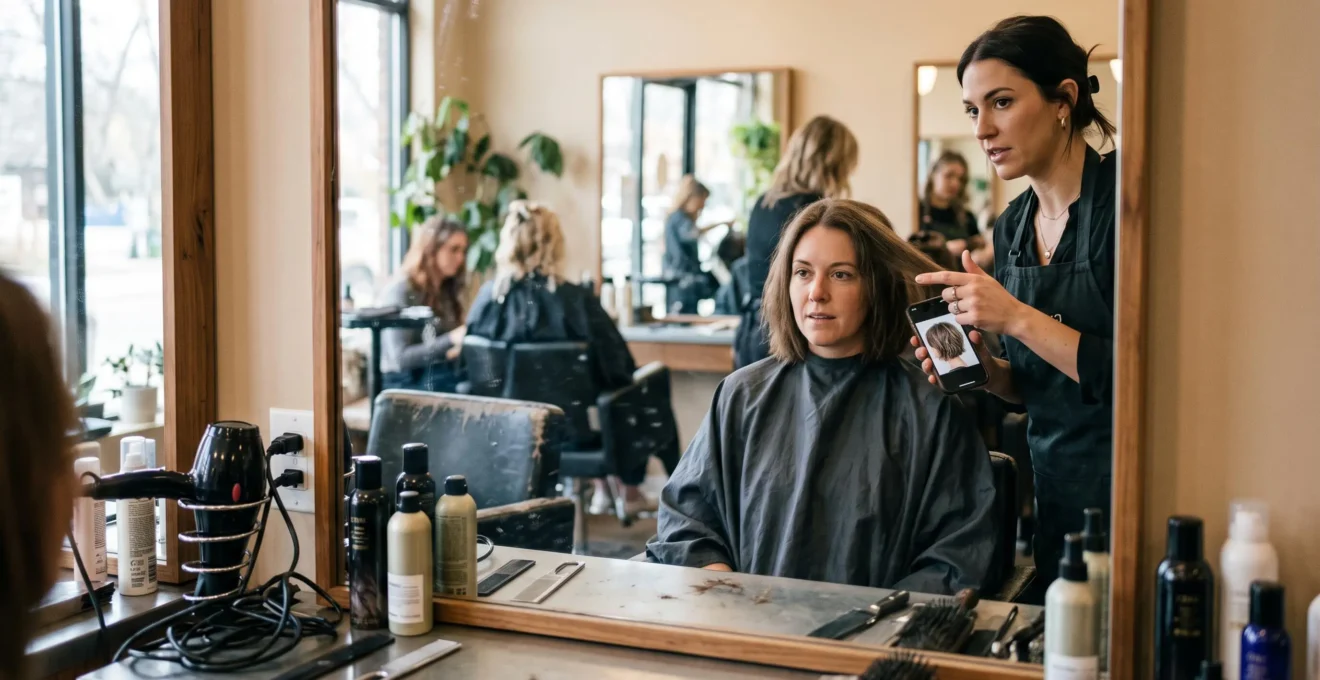
Getting consistently good results from a professional hairstylist involves more than finding someone talented and asking for the same haircut each time. Your hair changes, styling techniques vary, and even familiar descriptions can mean different things to different professionals.
The most reliable approach is to establish a shared understanding of the desired result, document what worked previously and agree on realistic maintenance requirements. That means discussing shape rather than length alone, revealing previous chemical treatments and checking the developing result before the appointment ends.
Consistency also depends on the relationship between your expectations and your hair’s actual behaviour. A cut that looks identical when freshly blow-dried may behave differently after several washes. A colour formula that worked previously may need reassessment when the starting colour or hair condition changes.
Whether you visit the same UK salon regularly or alternate between professionals, a few practical habits can make appointments more predictable without requiring you to understand professional cutting or colouring techniques.
How to make your salon results more consistent
- Agree on the intended shape, colour, length and everyday styling requirements before the service begins.
- Keep photographs and records of successful appointments, including previous colour treatments and relevant product information.
- Give specific feedback during the appointment, and book a consultation when the planned transformation needs additional assessment.
- Why Do Salon Results Vary So Much Even When You “Ask for the Same Thing”?
- How Do You Tell Your Stylist Something Feels Wrong Without Making It Awkward?
- New Stylist or Same Stylist: Which Choice Makes Sense After 2 Disappointing Visits?
- The Hair History Detail People Hide That Can Ruin a Colour Appointment
- When Should You Book a Consultation Instead of a Full Service to Avoid Wasting Money?
- How Do You Ask for a Professional Cut in 2 Minutes Without Getting the Wrong Shape?
- The Booking Mistake That Leads to Orange Tones Even in a Salon Appointment
- Which Professional Cut Still Looks Good After 8 Weeks Without Constant Styling?
Why Do Salon Results Vary So Much Even When You “Ask for the Same Thing”?
Salon results vary because repeating the same request does not necessarily reproduce the same technical decisions or starting conditions. Words such as “trim”, “layers” and “caramel” can describe several outcomes. Hair texture, previous treatments, cutting techniques and finishing methods also influence the result, even when the client and stylist believe they have agreed on the same look.
Communication is only one source of variation. Three factors deserve attention:
- Initial interpretation: The stylist translates your description into a cutting shape, colour formulation or finishing technique.
- Your hair’s starting condition: Density, texture, porosity, existing shape, previous chemical treatments and scalp condition can affect what is achievable.
- Execution and finishing: Sectioning, tools, product choices, processing decisions and drying techniques can change the appearance of the finished result.
Consider a client who asks for “soft layers” at two different salons. One stylist may create subtle movement around the face; another may remove more weight throughout the lengths. Neither interpretation necessarily contradicts the original request, because the desired silhouette was never precisely established.
Photographs help, but they also introduce ambiguity. A reference picture may show professionally smoothed hair, artificial lighting or a texture different from yours. The stylist needs to identify which elements matter: the outline, the movement, the fringe position or the colour itself.
A useful diagnostic exercise is to compare two appointments using the same reference photograph and a consistent description. If both results miss the same feature, the desired outcome may need clearer explanation or may not be achievable without different styling. If the results differ considerably, investigate technique, starting condition and finishing methods.
This comparison is a practical discussion tool, not a controlled test: hair growth, environmental conditions and previous services may also contribute to differences.
Once the difference is clearly identified, the next challenge is explaining it constructively while the stylist can still respond.
How Do You Tell Your Stylist Something Feels Wrong Without Making It Awkward?
Tell your stylist something feels wrong by describing the specific difference you notice, asking for a technical explanation and stating your preferred outcome. Raise concerns as early as possible rather than waiting until the final reveal. A calm, precise question gives the stylist a better opportunity to explain the process or make an appropriate adjustment.
A useful approach has three stages. First, describe what you can see: “The front looks shorter than it did in the reference photograph.” Next, ask whether the difference will remain after drying: “Will it sit differently once it’s styled?” Finally, explain what you prefer: “I’d like to preserve a little more length around my face if possible.”
These statements avoid blame while making the concern understandable. They also distinguish a temporary appearance during cutting from a problem with the intended finished shape.
Timing matters because not every correction is reversible. Excess length can sometimes be removed later, but hair that has already been cut too short cannot be restored during the appointment. If the stylist is approaching a length you are uncomfortable with, speak before additional cutting takes place.
Different concerns require different conversations. An apparent technical defect, such as an obviously uneven section that was not agreed upon, should be raised directly and promptly. A matter of taste, such as preferring less volume, calls for a discussion about achievable adjustments. An unrealistic expectation, such as obtaining the exact movement of a heavily styled photograph without home styling, requires revisiting the original goal.
Silence can create another problem. If you say everything is fine despite disappointment, the stylist may reasonably assume the service met your expectations and repeat the same approach next time.
When a concern emerges only after washing or styling your hair at home, contact the salon, describe the difference and ask about its review or adjustment policy. A photograph of your hair in its normal condition may help.
Good feedback also reveals whether the existing stylist understands your preferences well enough to improve the next appointment.
New Stylist or Same Stylist: Which Choice Makes Sense After 2 Disappointing Visits?
After two disappointing appointments, decide whether to stay with your stylist by examining the pattern of problems and how the professional responded to feedback. Repeated misunderstandings may be resolved through a clearer consultation, whereas inconsistent technique or dismissed concerns may justify changing stylists. Two disappointing results alone do not establish where responsibility lies.
The most useful distinction is between a repeated problem and unrelated failures. If your hair has been cut shorter than requested twice, investigate whether both of you interpret the agreed length in the same way. If one visit produced an unsuitable cut and another an unexpected colour result, review the professional’s technical process and whether the services matched their experience.
Neither pattern proves a particular cause. A repeated length problem could also reflect a cutting decision, and two different disappointments could arise from separate communication issues.
Before deciding, consider how your stylist handled the previous concerns. Did they listen, explain the result, document your preferences and suggest a realistic adjustment? Or did they dismiss your observations without considering what happened?
Changing stylists means rebuilding your appointment history. Your current professional may already know how your hair responds to particular products, how it grows and which shapes you dislike. That information has practical value, provided the working relationship remains constructive.
If you decide to move, give the new professional a concise record:
- Photographs of previous haircuts or colours you liked and disliked.
- Known previous colour treatments, including home applications.
- Products and formulas used, where that information is available.
- Previous adverse reactions or sensitivities that require appropriate safety assessment.
- Your normal styling routine and the specific problems you want to avoid.
A third appointment with the original stylist can be a practical opportunity to evaluate an agreed improvement plan, but it is not a statistically reliable test. Similar outcomes may indicate a repeatable approach, while continued differences warrant further investigation.
Where the concern involves hair damage, unsafe practice or a professional who refuses to address a substantial problem, there is no reason to treat a third visit as obligatory.
Whether you stay or switch, an accurate record of previous treatments is particularly important before booking any chemical service.
The Hair History Detail People Hide That Can Ruin a Colour Appointment
The easily overlooked detail is previous chemical or colour treatment, including old home dyes, henna, colour-depositing shampoos and earlier bleaching. Even when the visible colour has faded, treated lengths may still differ from untreated hair. Telling your stylist exactly what was applied helps them assess compatibility, colour possibilities and the risk of damage.
Clients sometimes assume that mentioning allergies and their desired shade is enough. For a colourist, however, the history of the hair itself can materially change the proposed service.
A permanent home dye applied several months ago may still affect the mid-lengths and ends. An earlier lightening treatment may have left those areas more porous or fragile. Products described as natural, including henna-based preparations, also need to be identified accurately rather than treated as automatically interchangeable with conventional colour.
Not every previous product causes a problematic reaction. The outcome depends on its formulation, how it was used, what remains in the hair and the new treatment proposed. The point of disclosure is to allow assessment rather than assume a particular chemical reaction will occur.
Importantly, hair dye allergies can develop after previous uneventful applications. The FDA information on hair dye safety explains the possibility of sensitisation and advises following product testing instructions. A negative allergy alert test does not eliminate every risk.
A practical preparation method is to write down everything you remember applying over approximately the previous two years, including approximate dates, brands and whether the treatment covered the whole head or selected sections. This is a useful recall window, not a universal safety standard; disclose older treatments too if treated hair remains or the product may be relevant.
With incomplete information, a colourist may recommend further assessment, testing or a different service. They may also postpone or decline a treatment if the risk cannot be assessed adequately. Discuss any potential additional charges before agreeing to corrective work.
Never conceal a previous adverse reaction. Burning, swelling, itching or other suspected allergy symptoms should be reported, and suspected allergic reactions warrant appropriate medical advice rather than simply trying another dye.
Once the starting condition is understood, the next decision is whether to proceed with a full appointment or arrange a dedicated consultation first.
When Should You Book a Consultation Instead of a Full Service to Avoid Wasting Money?
Book a consultation before a full service when the result involves substantial change, uncertain hair condition, previous chemical treatments or expectations that need technical clarification. A consultation allows the stylist to assess feasibility, discuss likely stages and explain potential costs before committing to the treatment. It cannot guarantee the result, but it can prevent an unsuitable booking.
The consultation’s main financial benefit is reducing uncertainty. A short assessment may involve a separate charge, be complimentary or form part of a booked service, depending on the salon. The actual saving comes from identifying complications before paying for a service that cannot reasonably deliver the intended result.
A separate consultation is particularly useful for major length changes, extensive lightening, colour correction, chemically treated or fragile hair, and first appointments where the professional does not yet know your hair. It is also valuable when you have reference photographs but struggle to explain what you actually want to retain or change.
For UK salons, the National Hair & Beauty Federation guidance on salon consultations and testing emphasises assessing hair and scalp condition before chemical services and maintaining appropriate consultation and testing records. Its discussion of testing and record retention includes particular insurance arrangements; these should not be presented as universal legal requirements for every salon.
A successful consultation should produce decisions, not merely a friendly conversation. You should leave knowing what can be attempted, which compromises may be necessary and what additional preparation or appointments are expected.
Your five-step consultation preparation checklist
- Save two reference photographs: one showing the desired result and one showing a result you want to avoid. Deliverable: a labelled visual brief.
- Write down previous treatments: record approximate dates, products and any reactions. Deliverable: a hair history note.
- Define your non-negotiables: specify minimum length, colour boundaries and daily styling time. Deliverable: three written constraints.
- Confirm the proposed service: ask about feasibility, testing, session requirements and possible compromises. Deliverable: an agreed treatment outline.
- Clarify the commitment: request the estimated cost, appointment duration, follow-up requirements and maintenance plan. Deliverable: a written or otherwise recorded service estimate.
Timing can also affect your options. For a substantial colour transformation, arranging the consultation well before the intended service date may allow time for assessment, necessary tests or changes to the plan. Several weeks may be helpful in some circumstances, although no universal interval guarantees better hair condition or a safer outcome.
For a routine haircut, however, a concise and well-structured briefing may be enough to establish the desired shape without a separate appointment.
How Do You Ask for a Professional Cut in 2 Minutes Without Getting the Wrong Shape?
Explain your desired haircut in two minutes by showing a clear reference photograph, stating one practical constraint and identifying one feature you do not want. Ask the stylist to explain the planned silhouette before cutting begins. This short briefing is more useful than simply requesting a particular length because it defines both the appearance and its everyday usability.
Start with a photograph showing the hairstyle from an angle that reveals the outline. If the image has heavily styled waves, extensions or an unusual finish, make clear whether you want the cut underneath or the full styled appearance.
Next, explain a constraint such as: “I spend no more than five minutes styling my hair in the morning.” Finally, state a boundary: “I don’t want a fringe, and I need the shortest sections to remain below my shoulders.”
These three pieces of information give the stylist a visible objective, a maintenance requirement and a clear restriction.
Length does not define shape. Two haircuts ending at the collarbone may look very different. One might have a blunt perimeter and substantial weight at the ends; another could feature internal layers and face-framing pieces that create a lighter outline.
Clarify potentially ambiguous expressions such as “textured”, “graduated”, “thinned out” and “structured”. Ask the stylist to point to the proposed shortest layer, show where the weight will sit and describe the finished shape in ordinary language.
During the haircut, request an opportunity to review the shape before the final finish. Wet hair can look longer or behave differently once dry, particularly when natural curl or wave is involved. A dry check in a style close to your usual routine can expose differences that are less obvious while the hair is wet.
That check should happen when the cutting process permits it; a fully finished blow-dry is not always practical halfway through a haircut.
Clear instructions should begin even earlier for colour appointments, where the service selected at booking determines the time available for the intended transformation.
The Booking Mistake That Leads to Orange Tones Even in a Salon Appointment
One booking mistake that can contribute to unwanted orange tones is choosing a short or routine colour service for a more complex lightening job. Previously coloured hair may reveal warm underlying pigments as it lightens, and achieving the desired shade may require additional assessment or treatment. However, orange results have several possible causes, not simply an incorrect booking.
For example, a client with previously dark-dyed hair may select a standard highlights appointment while expecting a cool, significantly lighter blonde. The salon might not have allocated enough time for the necessary assessment, lightening and tonal adjustment, particularly if the colour history was not disclosed when booking.
As hair lightens, underlying warm tones become visible. A toner can sometimes adjust those tones, but it cannot replace the additional lift needed when hair has not reached a suitable underlying level. The appropriate approach depends on the starting colour, hair condition and intended result.
Major colour changes also involve hair-health considerations. The American Academy of Dermatology recommendations on colouring and perming explain that substantial lightening can involve stronger peroxide exposure and increased hair damage. This is a safety consideration, not a fixed limit on what a qualified colourist can achieve.
Describe your starting point when making the appointment. Mention whether your hair has been coloured, when the treatments occurred, whether they were applied at home and how much lighter you want to become. Send recent photographs if the salon accepts them, ideally taken in natural lighting.
Ask whether the requested result fits the selected service or requires a separate consultation, colour correction appointment or staged treatment plan.
A gradual transformation may be preferable when the hair cannot safely tolerate a larger change in one session. It may also require additional appointments and a higher overall cost. Conversely, a longer single appointment may be suitable for some clients after professional assessment, but extra time alone does not guarantee a particular shade.
If the result remains warmer than agreed, ask the colourist what level of lift was achieved, whether further treatment is advisable and what can realistically be adjusted without excessive damage.
Reliable results are not only about colour on the day: a successful salon plan also considers how the haircut will look and behave as it grows out.
What to remember before your next salon appointment
- Evaluate the intended result on your hair’s natural texture, not only under professional salon styling.
- Discuss how the cut will change between appointments rather than judging it solely on the first day.
- Choose a maintenance routine that fits your actual time, tools and styling confidence.
Which Professional Cut Still Looks Good After 8 Weeks Without Constant Styling?
A haircut that can still look good after eight weeks is one whose shape grows out gracefully on your particular hair texture, density and growth pattern. Simple perimeters, carefully balanced longer layers and shapes that work with natural movement may be suitable options. No haircut can reliably promise eight weeks of attractive, effortless wear for everyone.
The crucial question is not only how quickly hair grows but how the intended design changes as it grows. A sharply defined fringe, precise geometric outline or tightly graduated section may need more frequent attention to preserve its original appearance. A softer shape can sometimes accommodate visible growth with less disruption.
These are professional styling considerations rather than universal longevity rankings. A blunt cut may remain visually balanced on one person but become difficult to manage on another whose hair grows unevenly or expands with humidity.
Instead of asking for the cut that lasts the longest, ask the stylist how the proposed shape is likely to behave at the halfway point before your next appointment. They can discuss where weight may accumulate, how face-framing sections will sit and whether the perimeter will remain balanced.
Maintenance difficulty depends on your routine. A haircut that requires a round-brush blow-dry may feel effortless to someone who already uses that technique, but demanding to someone who normally air-dries. Similarly, a shape that works naturally on wavy hair may require regular heat styling to look similar on very straight hair.
The American Academy of Dermatology advice on styling without damage explains that excessive heat and certain mechanical styling practices can damage hair, while appropriate care depends partly on texture. This supports planning a realistic routine, although it does not establish which particular cuts remain attractive after eight weeks.
For a lower-maintenance result, discuss how the proposed cut looks when air-dried, how often you are prepared to use heat tools and which features you are willing to let grow out between visits. A professional can then adapt the shape to your habits rather than expecting you to recreate a salon finish every morning.
Fine, straight hair and thick, wavy hair may require different weight distribution, layer placement and finishing choices. Neither texture has a universally predictable advantage in how long a haircut remains flattering.
Before your next booking, save a photograph of your most successful haircut after several weeks of normal wear. Show it alongside the original salon result and ask your stylist to design a shape that looks good at both stages, with a maintenance schedule you can realistically follow.
Should you take photographs after every successful salon appointment?
Photographs are useful records, especially when they show the front, sides and back in consistent lighting. Include an image after styling your hair normally at home, since the salon finish may not reflect your everyday routine. Photographs cannot reproduce the original cutting technique or colour formula, but they help establish a more precise visual reference.
Can a stylist repeat exactly the same colour formula at every visit?
A stylist can record and reuse a previous formula when appropriate, but repeating the mixture does not guarantee an identical result. Regrowth, previous colour build-up, hair porosity and condition may have changed. The colourist should assess the current starting point before deciding whether the previous formula remains suitable.
Is it reasonable to ask your salon to keep notes about your preferences?
Yes. You can ask whether the salon records your preferred shape, colour formulations, relevant treatments and previous service outcomes. Such notes can support continuity, particularly when another stylist takes over. Ask what information is retained, how it is used and whether you can receive a copy of relevant service details.
What should you do if your hair looks different after the first wash?
First, compare the appearance with the styling method discussed during the appointment. A salon blow-dry may temporarily alter movement, volume or smoothness. If the cut or colour still seems substantially different from what was agreed, take clear photographs and contact the salon promptly to explain the concern and request an assessment.
Can changing shampoo or styling products affect the consistency of a salon result?
Yes. Different cleansing, conditioning and styling products can change how hair feels, behaves and holds a finished style. Colour appearance may also be affected by fading and environmental exposure. If you notice a significant difference between visits, tell your stylist which products and styling methods you have changed so they can assess their possible contribution.