
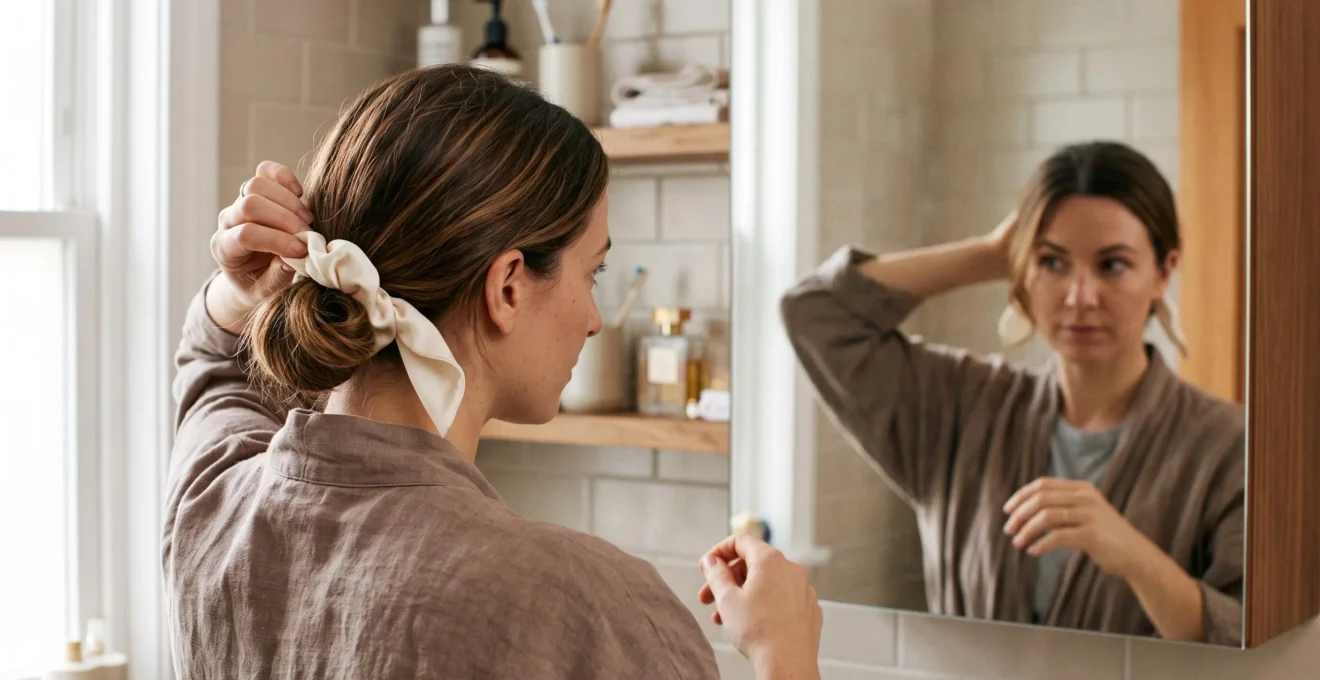
A silk scrunchie can be worth using even if your ponytail still leaves a dent. Its smooth surface may reduce friction between the accessory and your hair, helping limit one potential source of mechanical damage. However, it cannot eliminate the pressure created when hair is held in the same position for hours. The way you tie your hair, the size of the scrunchie and the length of time you wear it all matter.
For UK readers trying to protect their hair without sacrificing a secure hairstyle, the practical goal is not necessarily to eliminate every temporary crease. It is to reduce unnecessary pulling, friction and repeated stress on the same sections of hair. A faint indentation that disappears after releasing a ponytail is different from persistent breakage or thinning around the hairline.
Choosing silk is therefore one part of a gentler styling routine, rather than a complete solution. A comfortable fit, a suitable accessory size and regular changes in hairstyle are equally important, especially if you wear your hair up throughout the working day or overnight.
Silk Scrunchies: The Essential Takeaways
- Silk may reduce friction, but it cannot prevent every dent caused by prolonged pressure or a tightly secured hairstyle.
- Choose a scrunchie that holds your hair without pulling at the roots, and change its position when discomfort develops.
- For overnight styling, consider the accessory’s size, fabric construction and tendency to slip, rather than assuming that silk alone guarantees better protection.
- Why Do You Still Get Ponytail Dents With Silk Scrunchies?
- How Do You Tie a Silk Scrunchie So It Holds Without Pulling at the Hairline?
- Silk or Satin: Which Fabric Protects Hair Better Overnight Without Slipping Off?
- The Oversized Scrunchie Mistake That Causes Tangles at the Nape
- When Should You Switch From a Scrunchie to a Clip During a Long Day?
- Claw Clip or Barrette: Which Looks More Polished for Shoulder-Length Hair?
- When Is the Best Time to Braid Hair After Washing If You Want Maximum Grip?
- Which Decorative Hair Clip Actually Holds Fine Hair All Day Without Sliding?
Why Do You Still Get Ponytail Dents With Silk Scrunchies?
Yes, a silk scrunchie can still leave a ponytail dent because the crease is influenced by pressure, hairstyle position and wearing time, not just fabric friction. Silk may make contact with the hair gentler, but it cannot stop strands from being compressed into a particular shape. A loose, well-positioned ponytail may leave less of a mark than a tight one made with the same accessory.
The distinction between a temporary crease and actual hair damage is important. A temporary dent is a change in the arrangement of the hair that may become less noticeable when the hair is released and allowed to settle. Its appearance can also be influenced by moisture, natural texture and the direction in which the hair was gathered. It does not automatically indicate breakage.
Repeated mechanical stress is a different concern. Continually pulling hair into tight ponytails, buns or braids can contribute to breakage and, over time, traction alopecia. The American Academy of Dermatology explains the risks of hairstyles that pull in its guidance on hairstyles that cause traction. Pain, stinging, broken hairs around the forehead or a receding hairline should not be dismissed as ordinary styling marks.
Where the dent appears can help identify the likely cause:
- At the roots or crown: the ponytail may have been positioned too tightly or held in one place for too long.
- Along the mid-lengths: the hair may have been bent sharply around the elastic or compressed inside the gathered section.
- At the edge of a bun: the accessory may be too narrow, or the bun may have been wrapped too tightly around its base.
Use these observations as practical clues, not a definitive diagnostic test. Hair texture, length and moisture can all influence the appearance of a crease. If you notice persistent thinning or repeated breakage, changing accessories alone may not be sufficient.
A five-step ponytail dent check
- Remove the scrunchie and record where the crease appears: roots, mid-lengths or bun edge.
- Loosen the hairstyle and note whether the indentation becomes less visible as the hair settles.
- Check for discomfort, scalp stinging or broken hairs around the hairline.
- Try a lower, looser hairstyle and record whether the crease changes.
- Compare the result after changing the accessory’s size or position, changing one variable at a time.
The useful takeaway is that a dent does not automatically mean a silk scrunchie has failed. If the crease is your only concern, adjusting the hairstyle may help; if pulling or breakage is present, reducing tension becomes the priority. The next step is to make the scrunchie secure without tightening it unnecessarily.
How Do You Tie a Silk Scrunchie So It Holds Without Pulling at the Hairline?
The best way to tie a silk scrunchie is to gather the hair without pulling it taut, distribute the hold across the gathered section and stop tightening as soon as the hairstyle feels secure. A ponytail does not need to feel rigid to stay in place. The right combination of positioning, hair distribution and accessory size can provide a practical balance between hold and comfort.
Start by detangling your hair gently, then gather it at the height you want. Avoid pulling the front sections backwards so tightly that the skin around your temples feels stretched. Keep the gathered hair relaxed rather than flattening every strand against the scalp.
Pass the scrunchie around the ponytail or bun, using only as many wraps as needed to hold the style. The exact number depends on the accessory’s circumference, its internal elastic and the amount of hair being secured. A scrunchie that needs excessive tightening is not necessarily the right size for your hairstyle.
A simple comfort check can help you assess the result. Try sliding two fingers beneath the elastic where it sits against the hair. If the accessory digs into the scalp, the skin feels pulled or the hairstyle causes discomfort, loosen it. This is a practical styling check, not a clinically validated test or a guarantee against damage. A hairstyle can also be too tight even when the elastic itself feels soft.
Position matters, too. A high bun may create more pulling around the temples and front hairline, especially when the hair is long or heavy. A low bun often reduces that upward pull, although its stability will depend on how the hair is gathered and secured.
The American Academy of Dermatology’s recommendations for styling hair without damage emphasise gentle handling and avoiding hairstyles that create sustained tension. For most hair types, it also recommends allowing hair to partially air-dry before styling or combing. Haircare needs can differ for tightly curled or textured hair, so detangling methods should reflect the hair’s individual needs.
A scrunchie that holds without pulling is a better everyday choice than one that requires constant tightening. If the style still slips despite a comfortable fit, examine the fabric and internal elastic before increasing the tension.
Silk or Satin: Which Fabric Protects Hair Better Overnight Without Slipping Off?
Neither silk nor satin is automatically the better choice for every overnight hairstyle. Silk is a natural fibre, whereas satin describes a weave structure that can be made from silk, polyester or other fibres. A smooth surface may help reduce friction, but the accessory’s construction, internal elastic and fit also determine how securely it stays in place while you sleep.
Silk is a protein-based natural fibre with a smooth surface. Satin is defined by its weave, which creates a characteristic smooth, lustrous finish. The distinction matters because a silk satin scrunchie and a polyester satin scrunchie do not necessarily have the same material properties. Fabric composition and construction both influence how an accessory feels and behaves.
The textile explanation in Architectural Digest’s guide to satin weave construction illustrates why satin should not be treated as a synonym for silk. Neither the name of the fibre nor the name of the weave alone establishes which scrunchie will protect hair better.
For overnight use, smoothness has a trade-off: a very slippery surface may allow the accessory to move more easily over the hair. A scrunchie that stays in place should still be comfortable and should not require excessive tightening to compensate for slippage.
The choice depends on your hair and sleeping habits:
| Hair type or need | What to look for | What to watch for |
|---|---|---|
| Fine hair | A lightweight scrunchie with enough hold to secure a loose style. | Excess fabric, heavy accessories or an elastic that slips repeatedly. |
| Thick or heavy hair | A more substantial construction and an internal elastic that holds the gathered hair comfortably. | Repeated tightening or an accessory that cannot support the hair without pulling. |
| Curly, coily or textured hair | A smooth covering with no rough seams and a comfortable, sufficiently secure internal elastic. | Snagging, concentrated pressure and friction during overnight movement. |
| Hair that slips during sleep | A suitable fit, secure construction and a less bulky shape that remains comfortable. | Assuming that a more expensive fabric or a higher silk weight will automatically solve slippage. |
When shopping, inspect the fabric thickness, the coverage of the internal elastic and the seam finish. A flat, smooth seam is preferable to a stiff ridge that presses against the hair. Silk weight, sometimes described in momme, can help characterise a silk fabric, but it does not independently establish how well a finished scrunchie will hold overnight.
For sleep, also consider how you arrange the hair and whether it remains comfortable when your head rests against the pillow. A silk or satin pillowcase may reduce friction between the hair and bedding, but that is a separate consideration from the scrunchie’s grip. Cleveland Clinic‘s dermatologist-led advice on sleeping with wet hair notes that wet hair is more vulnerable to breakage and that reducing friction against the pillow may help.
The practical winner is the scrunchie that holds your hair without pulling, snagging or shifting excessively. If both fabrics meet those conditions, choose based on comfort, maintenance and personal preference rather than assuming that one material is universally superior.
The Oversized Scrunchie Mistake That Causes Tangles at the Nape
An oversized scrunchie can create tangles at the nape when excess fabric shifts, folds or catches against the hair during sleep. A larger accessory is not automatically gentler: it may spread contact over a wider area, but it can also add bulk and movement. The aim is to choose a size that accommodates the hairstyle without leaving unnecessary fabric hanging or bunching against the hair.
The problem is especially noticeable when shoulder-length hair is gathered into a small bun. A large scrunchie may appear soft and luxurious around the bun, yet its loose fabric can extend beyond the gathered hair. When you move your head against the pillow, that extra material may shift or fold back on itself.
At the nape, where the hair and pillow can come into repeated contact, loose strands may catch in folds or become tangled around the accessory. The result can be localised knots that are difficult to separate gently in the morning. This is a practical possibility rather than an inevitable consequence of wearing a large scrunchie.
There is no universal diameter that suits every hairstyle. The amount of hair, bun shape, accessory elasticity and intended use all affect the fit. Instead of choosing by the accessory’s overall size alone, compare it with the actual bun or ponytail you intend to secure.
Use this visual check when tying your hair:
- The scrunchie should fit around the gathered section without requiring excessive stretching.
- The fabric should sit around the bun rather than hanging in long, loose folds.
- The accessory should not create a hard, bulky contact point where the head rests against the pillow.
- The ends of the hair should remain contained without being forced sharply against the nape.
For shoulder-length hair, a compact, relaxed bun may work better than wrapping the hair into a tight knot and covering it with an oversized scrunchie. If you wake up with knots in the same area repeatedly, try a smaller accessory or a different overnight arrangement and compare the results.
A generously sized scrunchie can still be useful when it matches the volume of the hairstyle. The mistake is treating size as a substitute for fit: a smaller, comfortable accessory may be the more practical choice if excess fabric repeatedly tangles the hair at the nape.
When Should You Switch From a Scrunchie to a Clip During a Long Day?
Switch from a scrunchie to a clip when your current hairstyle becomes uncomfortable, repeatedly slips or leaves a noticeable pressure mark that suggests the fit needs adjusting. Changing accessories can alter where pressure is applied and how the hair is supported. However, a clip is not automatically gentler than a scrunchie; its shape, weight and grip must also suit your hair.
Three practical signals can help you decide whether to change your hairstyle:
- Persistent tension: the roots, temples or hairline feel uncomfortable after several hours.
- Repeated creasing: removing the scrunchie reveals a pronounced mark in the same place each time.
- Constant readjustment: you repeatedly tighten or retie the hairstyle because the accessory keeps slipping.
If any of these occurs, first loosen or remove the scrunchie. There is no need to wait until the end of the day if the hairstyle hurts. The American Academy of Dermatology identifies pain and scalp discomfort as warning signs that a hairstyle may be too tight.
Alternating between a scrunchie and a clip can also help vary the points of contact. A scrunchie may be convenient for a relaxed ponytail in the morning, while a suitably sized claw clip may hold the hair up in the afternoon without requiring the same wrapped ponytail shape.
A simple routine might look like this:
| Part of the day | Possible choice | Reason to change |
|---|---|---|
| Morning | A comfortable silk scrunchie. | Begin with a secure style that does not pull at the roots. |
| Afternoon | A suitable claw clip, if needed. | Change the pressure points if the original style becomes uncomfortable or slips. |
| Evening | A relaxed scrunchie style or loose hairstyle. | Remove unnecessary tension before resting or sleeping. |
This is an example, not a mandatory schedule. If a well-fitted scrunchie remains comfortable throughout the day, there is no need to change accessories simply because a certain number of hours has passed.
The important distinction is between a hairstyle that stays secure comfortably and one that demands repeated tightening. If a clip also causes pressure or snagging, change its size, position or design rather than forcing it to work.
Claw Clip or Barrette: Which Looks More Polished for Shoulder-Length Hair?
For shoulder-length hair, a claw clip is often the more practical option when you want to lift the hair without wrapping it into a tight ponytail or bun. Its teeth can grip a gathered section without requiring the same narrow elastic-style fastening. A barrette can look more refined for certain outfits, but its hold and pressure depend on the design and the amount of hair it needs to secure.
A claw clip is particularly useful when your hair is too short to form a full bun comfortably. Gather the hair loosely, twist it if needed and secure it with a clip that accommodates the thickness of the section. The goal is to hold the hair in place without forcing short layers into an awkward fold.
A barrette works differently. It typically fastens a section of hair between a clasp and its base. This can create a neat, polished finish, especially when securing a smaller section at the side or back of the head. However, a narrow fastening point may concentrate pressure, and a barrette that is too small may not hold the gathered hair reliably.
The main differences are practical rather than absolute:
| Criterion | Claw clip | Barrette |
|---|---|---|
| Everyday hold | Useful for securing a gathered section or loose twist. | Useful for smaller sections when the clasp fits the amount of hair. |
| Styling effect | Can create a relaxed updo with visible volume. | Can create a neat, more decorative finish. |
| Pressure | May create pressure at the teeth or hinge if too tight or poorly positioned. | May concentrate pressure around the clasp if the section is too thick. |
| Potential for creasing | May reduce the need to wrap hair tightly, but can still bend strands at the grip. | May leave a localised mark where the fastening presses against the hair. |
The most polished result is not necessarily the most tightly secured one. Choose a clip that holds without pulling individual strands, pinching the scalp or requiring repeated adjustments. If you are trying to reduce ponytail dents, a claw clip can be a useful alternative because it changes how the hair is gathered and supported. It does not guarantee a crease-free result.
Consider keeping both options available: a claw clip for a relaxed updo and a barrette for a smaller, more structured style. Alternating them when useful can help avoid relying on the same fastening point throughout the day.
Key Takeaways Before Choosing a Decorative Hair Clip
- Match the clip to the amount of hair it needs to secure, especially if your hair is shoulder-length or fine.
- Check for concentrated pressure at the hinge, teeth or clasp rather than judging comfort by appearance alone.
- Choose the fastening style that remains secure without requiring repeated tightening or pulling at the hairline.
When Is the Best Time to Braid Hair After Washing If You Want Maximum Grip?
For a practical starting point, braid hair after it has partially air-dried rather than immediately after washing when it is dripping wet. Wet hair is generally more vulnerable to stretching and breakage, particularly when it is handled or rubbed against bedding. The best timing also depends on hair texture, styling goals and how your hair behaves as it dries; there is no universally established moisture percentage that guarantees a stronger braid.
A useful styling rule of thumb is to wait until the hair is roughly 80–90% dry before braiding, particularly when preparing a loose overnight style. This is a practical estimate, not a clinically established threshold or a figure validated by comparative research on braid grip. Hair should no longer feel visibly wet, but it may retain a little flexibility.
The American Academy of Dermatology recommends allowing hair to partially air-dry before styling or combing. Its advice also recognises that tightly curled or textured hair may benefit from a different approach to detangling. Avoid treating a single drying rule as suitable for every hair type.
For overnight styling, it is also sensible to let the hair dry before going to bed. Cleveland Clinic dermatologist Shilpi Khetarpal explains that wet hair is more fragile and that friction against a pillowcase can contribute to breakage. A braid does not remove those concerns if the hair is still very wet or tied too tightly.
The aim is a braid that feels comfortable and stays in place without requiring an overly tight scrunchie at the end. If the braid loosens, consider whether the sections were gathered evenly, whether the braid suits your hair texture and whether the finishing accessory is appropriate.
Use the 80–90% estimate as a flexible starting point, not a guarantee of grip or hair protection. If your hair remains damp for a long time, prioritise allowing it to dry adequately before sleeping and choose a loose, comfortable style rather than relying on a tighter fastening.
Which Decorative Hair Clip Actually Holds Fine Hair All Day Without Sliding?
For fine hair, the most reliable decorative clip is usually a lightweight design that can grip a small section securely without needing excessive clamping force. Closely spaced teeth, a suitable inner texture or a well-designed clasp may improve stability, but no single clip design works for everyone. The accessory must match the amount of hair being secured and remain comfortable during ordinary movement.
Fine hair can be difficult to secure because a decorative clip may have more surface area or weight than the section it is holding can comfortably support. Smooth metal surfaces may allow strands to slide, while a heavy accessory can pull the gathered section downwards. Increasing the clamping force is not always the answer: excessive pressure can make the clip uncomfortable or encourage snagging during removal.
Look for a clip with a lightweight construction, a fastening mechanism that closes securely and teeth or a clasp suited to the thickness of your hair. Some designs include textured inner surfaces or silicone details intended to improve grip. These features may help, but their effectiveness depends on the particular product and how it fits your hair.
The most decorative design is not necessarily the most functional. A large metal clip can look polished but feel unbalanced in a small section of fine hair. Conversely, a simpler, lighter clip may stay in place with less effort.
Before committing to a clip for an entire working day, test it with the hairstyle you intend to wear:
- Gather a small section of dry hair and position the clip as you normally would.
- Check whether the clip holds without pulling the scalp or trapping individual strands.
- Move your head normally for a few minutes and check whether the accessory shifts.
- Remove the clip carefully and look for snagged strands or a pronounced mark at the fastening point.
- If needed, repeat the test with a different size or design. A light styling product may change the grip, but it can also affect how the accessory slides.
This short test is a practical comparison, not a guarantee that a clip will remain secure under every condition. Hair length, texture, product use and the shape of the accessory all influence the result.
The best decorative clip is the one that remains comfortable, holds the intended section and comes out without snagging. Try different designs with your everyday hairstyle, and keep the option that provides reliable hold without forcing you to tighten or readjust your hair repeatedly. That is a more useful measure of performance than appearance or material claims alone.
Can silk scrunchies completely prevent ponytail dents?
No. Silk may reduce friction, but it cannot eliminate creases caused by prolonged compression, tight hairstyles or repeated pressure at the same point. Loosening the hairstyle, changing its position and choosing a suitable scrunchie can help reduce the factors contributing to visible dents.
Is it safe to sleep with a silk scrunchie every night?
A comfortable, loosely secured hairstyle may be suitable for overnight use, but the fabric alone does not guarantee protection. Avoid pulling the hair tightly, choose an accessory that does not create excess bulk at the nape and allow wet hair to dry before sleeping. If the style causes discomfort or repeated tangling, change the arrangement.
Does a more expensive silk scrunchie protect hair better?
Not necessarily. Fabric quality, construction, elastic coverage, seam finish, size and fit all matter. A premium material cannot compensate for an accessory that pulls too tightly or repeatedly slips. Compare the finished product’s comfort and performance rather than relying on price or silk weight alone.
Should you stop wearing ponytails if you notice breakage?
Reduce tight styling and vary how you wear your hair, especially if breakage appears around the hairline. Repeated pulling can contribute to traction alopecia. Pain, scalp stinging, broken hairs or a receding hairline warrant attention; seek advice from a qualified healthcare professional if symptoms persist or thinning develops.
Are claw clips better than scrunchies for fine hair?
It depends on the hairstyle and the clip’s fit. A lightweight claw clip may hold a loose twist without requiring a tightly wrapped ponytail, while a small, well-fitted scrunchie may be more convenient for other styles. Choose the option that stays secure without pulling, snagging or creating uncomfortable pressure.