
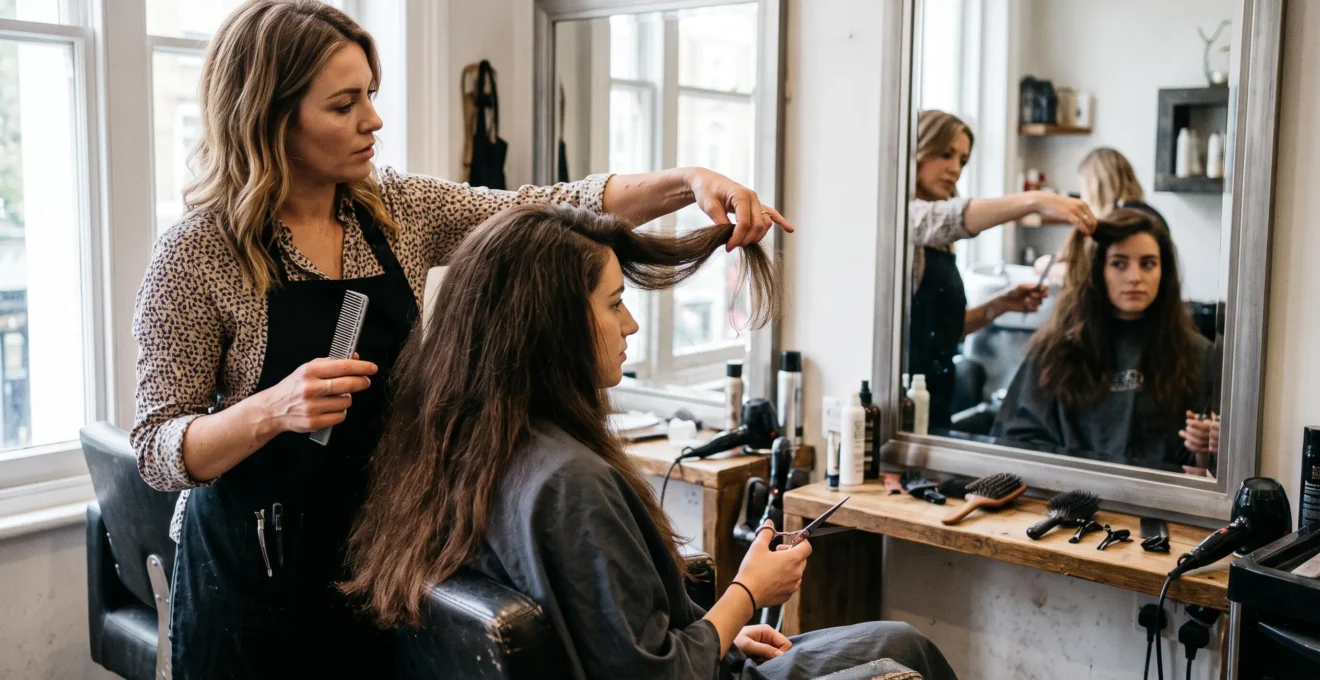
The secret to getting layers without sacrificing thickness is deciding where the weight should stay before deciding where it should go. A layered haircut can create movement, soften a heavy silhouette and make everyday styling easier. But poorly positioned layers can also leave the ends looking sparse, separated or noticeably thinner than expected.
For anyone with fine to medium hair, the difference matters particularly. You may have plenty of individual strands yet still lack the strand thickness needed to support aggressive layering. Even naturally thick hair can develop wispy ends when too much weight is removed from the wrong areas.
The safest salon request is specific: preserve a strong perimeter, introduce carefully blended layers where movement is needed, and avoid unnecessary thinning through the lower lengths. Your stylist should also know whether you normally air-dry, blow-dry or wear your natural texture.
Understanding how layering changes weight distribution makes it easier to request a flattering cut that works beyond the first salon blowout.
How to keep layers without losing fullness
- Protect the perimeter. Ask for a defined, full-looking baseline and avoid excessive thinning near the ends.
- Specify placement. Describe where you want movement, how visible the layers should be and where the shortest piece may fall.
- Start conservatively. Longer, blended layers are usually easier to maintain and adjust than dramatically short, heavily textured layers.
- Why Do Layers Make Some Haircuts Look Thinner Even When You Start With Thick Hair?
- How Do You Describe the Layers You Want So You Don’t Get « The Rachel » by Accident?
- Long Layers or Shag Layers: Which One Air-Dries Better With Minimal Fuss?
- The Layering Mistake That Creates a « Shelf » Shape on Wavy Hair
- When Should You Refresh Layers If Your Hair Starts Looking Bottom-Heavy Again?
- Why Does a Haircut Create a « Triangle Shape » on Thick Hair?
- Why Does Hair Still Look Heavy After You Ask for « More Movement »?
- How Do You Tell if a Haircut Will Grow Out Awkwardly After 6 Weeks?
Why Do Layers Make Some Haircuts Look Thinner Even When You Start With Thick Hair?
Layers can make thick hair look thinner because they redistribute or remove weight, especially when shorter sections extend through the lower lengths. The result depends less on whether hair is layered and more on where the layers begin, how much hair is removed and whether the perimeter remains substantial. Strategic layering can create movement without making the ends appear depleted.
Hair thickness involves two different characteristics: density, meaning how many strands occupy an area of the scalp, and strand diameter, meaning how fine or coarse each strand is. Someone can have high-density hair made of individually fine strands. That combination may look abundant before cutting but become visibly wispy when aggressively layered.
Two techniques can produce very different silhouettes:
- Structural layering uses planned differences in length to create shape, lift and controlled weight distribution.
- Texturising uses cutting techniques to soften or reduce bulk within sections, potentially creating a more separated finish.
These approaches can overlap. Internal layering can relieve heaviness through the middle of a haircut while maintaining more of its external outline. Conversely, extensive surface layering or texturising through the ends may reduce the apparent fullness of that outline.
Cutting elevation also matters, although it is not a universal thickness formula. Raising sections changes how lengths are distributed. High elevation, including sections held around 90 degrees or above, can create more layering through certain areas, depending on the guide and cutting pattern. Lower elevation can retain more weight in particular designs. Neither guarantees thick ends without considering the complete haircut.
The key qualification is that high elevation does not automatically preserve the perimeter. The stylist must deliberately design the cut to retain its outer weight line.
In Allure’s hairstylist recommendations for fuller-looking haircuts, professionals explain why a strong perimeter and restrained layering can make fine or thinning-looking hair appear fuller. That is guidance about visual density, not evidence that cutting changes the number of hairs on the scalp.
Before agreeing to layers, ask your stylist to examine both your strand diameter and overall density. A haircut suitable for coarse, densely packed hair may need significant modification when your strands are fine, even if you have plenty of them.
Preserving fullness starts with recognising that the cutting method must suit your individual hair, not simply reproduce the silhouette of someone else’s haircut.
How Do You Describe the Layers You Want So You Don’t Get « The Rachel » by Accident?
To avoid getting a heavily stepped, face-framing haircut when you wanted subtle layers, describe exactly where the layers should sit, how noticeable they should be and what they should achieve. Ask for a visible demonstration of the shortest proposed layer on dry hair, and make preserving the thickness of your ends an explicit requirement before cutting begins.
A reference to « The Rachel » can suggest dramatically visible layers around the face, but hairstylists may interpret that reference differently. Likewise, requesting « a few layers » leaves considerable room for interpretation.
Organise your request around three characteristics:
- Location: face-framing pieces, internal layers, crown layers or subtle movement near the ends.
- Visibility: softly blended layers or deliberately defined, separated sections.
- Purpose: reducing bulk, lifting the shape, framing the face or making natural movement more apparent.
For example, a useful salon request would be: « I’d like long, blended layers that add movement through the middle, but I want the bottom of my hair to look full. Please avoid short crown layers and excessive thinning near the ends. »
Reference photographs are useful, but a polished blowout may conceal where the layers actually fall. Bring photographs that show both styled and naturally dried hair if possible. Then ask your stylist to demonstrate the proposed length on your dry hair.
Allure‘s advice on requesting a layered haircut supports discussing everyday styling habits, beginning with conservative layering and assessing the finished result once the hair is dry.
Your five-step salon consultation checklist
- Define your desired result. Prepare one sentence explaining whether you want movement, reduced bulk or face framing while preserving fullness.
- Identify your shortest acceptable layer. Ask the stylist to show its proposed dry position and agree on a clear reference point.
- Confirm the perimeter. Ask whether the bottom outline will remain substantial, and obtain a clear description of the intended finish.
- Discuss the cutting tools. Ask whether ordinary scissors, thinning shears, point-cutting or a razor will be used, and why each is appropriate for your hair.
- Request a dry-hair check. Agree to examine the natural fall, blending and end fullness before the appointment finishes.
The safest principle is to begin with fewer layers than you might ultimately want. Additional movement can be introduced at a later appointment; excessively short layers cannot be immediately restored without changing the overall haircut.
A clear consultation should establish both the appearance you want and the amount of styling you are realistically willing to do at home.
Long Layers or Shag Layers: Which One Air-Dries Better With Minimal Fuss?
Long layers are generally the safer low-maintenance option when preserving full-looking ends is the main priority, especially on straight or fine hair. A shag may air-dry with more natural shape on wavy or curly hair, but its shorter crown and face layers can create a more separated outline. The better choice depends on natural texture and styling expectations.
Long layers keep more of the overall length working together. They can soften a heavy haircut without introducing a dramatic difference between the upper sections and the ends. On naturally straight hair, however, very subtle layers may need some styling to make their movement visible.
Shag haircuts deliberately use stronger length variation, often with shorter sections around the crown and face. Natural waves can enhance this shape as the hair dries. Fine, straight hair may instead fall into distinct pieces, making the lower lengths appear less substantial.
The main differences become clearer when comparing normal daily wear rather than salon-finished photographs.
| Consideration | Long layers | Shag layers |
|---|---|---|
| Visible end fullness | Generally easier to preserve | More dependent on layer placement and density |
| Air-drying straight hair | Soft result, sometimes limited movement | May need styling to define shorter sections |
| Air-drying wavy hair | Gentle movement with a fuller outline | Can enhance natural shape and separation |
| Styling commitment | Occasional diffusing or brush styling may help | Natural texture may do much of the shaping |
| Growing out | Often easier to blend into the overall length | Shorter sections may require more patience |
A shag does not necessarily require razor cutting or aggressive texturising. Those are optional techniques rather than essential characteristics. A skilled stylist can adapt the cut to preserve more fullness, although this may soften its deliberately textured appearance.
Wavy and curly clients should also account for shrinkage. Sections cut while stretched may settle noticeably higher when they return to their natural pattern. Assessing dry texture helps reveal the eventual silhouette, although some stylists successfully use wet cutting followed by dry refinement.
Choose long, blended layers if you want full ends, minimal styling and an adaptable grow-out. Consider a restrained shag if your natural waves already create definition and you are comfortable maintaining more pronounced differences in length.
The right low-maintenance haircut should look intentional in its natural state, not depend on a professional blowout to disguise its structure.
The Layering Mistake That Creates a « Shelf » Shape on Wavy Hair
A shelf shape appears when shorter layers form an obvious horizontal ledge above the longer hair instead of blending into a continuous silhouette. On wavy hair, differences in shrinkage, cutting tension and layer placement can exaggerate this separation. Correcting it requires evaluating how the hair naturally falls, not automatically cutting the bottom shorter or adding more layers.
Wave patterns do not necessarily shrink uniformly. One section may spring upwards more than another, causing layers that looked smoothly connected when stretched to appear disconnected once dry.
A strong, poorly blended cutting guide can make this effect more noticeable. If several sections finish around a similar visible height, they may create a prominent band of volume above comparatively sparse-looking ends.
Before cutting, a stylist can assess how your hair responds to tension:
- Select a representative section of naturally dry wavy hair.
- Gently stretch it to observe the difference between its relaxed and extended length.
- Release it and allow the wave to return naturally.
- Compare the relaxed position with the proposed shortest layer.
This is a practical visual assessment rather than a precise measurement of how every section will behave. Different parts of the head may have different wave patterns.
Professional approaches differ. Modern Salon‘s professional discussion of cutting curls and coils describes both wet and dry methods, highlighting the importance of anticipating shrinkage and avoiding excessive weight removal.
If you already have a shelf, ask the stylist to assess the internal transition before shortening the overall length. Selective point-cutting or other careful blending may soften certain hard lines, but these techniques also remove hair and may not suit every curl pattern. Some specialists prefer working with individual curls rather than texturising them.
The aim is to connect the visible lengths while retaining enough density beneath the shorter sections. If the discrepancy is substantial, gradual correction over multiple appointments may protect the ends better than an aggressive one-session repair.
For wavy hair, preserving thickness means planning the cut around the hair’s relaxed shape, not only its stretched cutting position.
When Should You Refresh Layers If Your Hair Starts Looking Bottom-Heavy Again?
Refresh your layers when their original shape stops working, rather than following a rigid appointment schedule. Signs include face-framing pieces losing their position, movement disappearing through the middle or weight accumulating near the bottom. A targeted layer refresh can rebalance the haircut while leaving the perimeter largely untouched, provided the existing ends remain in good condition.
As hair grows, the entire arrangement of lengths moves downwards. The original difference between shorter and longer layers does not simply disappear, but their positions relative to the shoulders, face and overall silhouette change.
This can make a once-balanced haircut feel bottom-heavy even if no cutting mistake occurred. It is a normal consequence of growth and changing proportions.
Consider the following signals:
- The original face-framing sections no longer fall where they flatter your face or blend comfortably with the rest of the cut.
- Natural movement appears concentrated at the ends instead of distributed through the middle.
- The haircut looks increasingly triangular or flat near the crown.
- Your usual styling routine takes more effort to achieve the former shape.
A useful distinction is whether you need a perimeter trim or a layer refresh. A light trim removes a small amount from the outline but may not restore the intended internal structure. Refreshing selected layers can restore movement without sacrificing much overall length.
When preserving thickness is the priority, ask to maintain the original layering design rather than introducing increasingly shorter sections with every visit. Your stylist may need to adjust the guides to accommodate growth, but this should be a deliberate decision.
Repeatedly adding new short layers can gradually reduce the amount of hair reaching the perimeter. That is particularly noticeable on longer cuts made from fine strands.
A photograph taken after your original haircut can provide a practical reference. Compare how the layers fell then with how they settle now, and identify the particular area that has lost its shape.
A good maintenance appointment should restore the proportions you liked, not restart the layering process from scratch.
Why Does a Haircut Create a « Triangle Shape » on Thick Hair?
A triangle-shaped haircut develops when the silhouette becomes noticeably wider towards the ends than near the top. On thick hair, this can happen when a one-length or minimally layered cut concentrates visual weight around the lower lengths. Carefully placed internal layers may reduce that widening while preserving a strong perimeter, but removing too much weight can create the opposite problem.
The effect is particularly noticeable when thick hair also has natural waves or curls that expand around the shoulders. A heavy baseline may be desirable for density, yet it does not automatically produce a balanced overall shape.
Simply asking for blunt ends will not necessarily solve the problem. Blunt cutting establishes a strong outline; it does not, by itself, change how weight and volume are distributed above that outline.
Two possible corrective strategies are worth distinguishing.
- Internal layering: redistributes weight through selected areas while maintaining the desired visible perimeter. This is often worth discussing first when you want flexibility and full-looking ends.
- Undercutting or removing weight underneath: reduces support or bulk in concealed sections. It may suit particular dense hairstyles but can create difficulties with styling, ponytails or growing out, depending on how much hair is removed.
Neither method is automatically right for all thick hair. A stylist should consider density, strand diameter, natural texture and where the unwanted width actually begins.
The most common overcorrection is removing too much internal weight in an attempt to eliminate every trace of width. This can leave an overly expanded upper section above thinner lower lengths, effectively exchanging one unbalanced shape for another.
A more conservative approach is to identify the area creating the unwanted width, remove only enough weight to change its behaviour, then reassess the dry result before continuing.
For clients with fine but abundant hair, restraint is especially important. The hair may initially appear thick enough for extensive bulk removal, but fine individual strands do not always maintain a full-looking perimeter once heavily layered.
The goal is to redistribute the existing volume so the haircut feels lighter without making the lower outline unnecessarily sparse.
Why Does Hair Still Look Heavy After You Ask for « More Movement »?
Hair can still look heavy after a layered haircut because « movement » describes the desired effect, not a precise cutting method. Your stylist may have added face-framing pieces or surface texture without changing the area responsible for bulk. Styling products and smoothing techniques can also disguise movement that is already present in the cut.
There are two useful ways to think about movement.
Visual movement is the impression of separated strands, changing directions or softly textured ends. A stylist may create it with styling, point-cutting or other finishing methods. It can make hair look lighter without substantially altering its overall shape.
Structural movement comes from the way different lengths are arranged. Carefully positioned layers can change how the hair falls, how much weight collects in particular areas and how naturally the silhouette responds to motion.
If you want movement without losing end thickness, ask where the stylist proposes to change the structure. For example: « The area around my shoulders feels too heavy, but I don’t want wispy ends. Can we create more movement through the middle while keeping the bottom line substantial? »
Before deciding that your haircut needs more layers, examine your styling routine. Heavy leave-in products, excessive smoothing creams or a very polished blowout may encourage separate layers to lie together, concealing the intended shape.
Try a simple comparison: wash as usual, use a lighter application of styling product and allow the hair to settle into its natural pattern. If appropriate for your texture, gentle scrunching or diffusing may help reveal movement without additional cutting.
The salon finishing check is equally valuable. Ask to see how the haircut falls when dry and gently moved, before the final styling fully fixes the silhouette. The stylist can then assess whether extra structural adjustment is actually necessary.
Changes can sometimes be made during the same appointment, but whether they are included without charge depends on the salon’s policy.
Only remove additional hair when the existing structure genuinely needs changing; a different finish may be all that is required.
What to remember before committing to a layered cut
- Plan the future shape, not just the first-day finish: the position of the shortest layer influences how the haircut will age.
- Keep the difference between upper layers and the perimeter manageable if you want fewer corrective appointments.
- Agree on a conservative cutting plan that can be adjusted later instead of relying on dramatic initial weight removal.
How Do You Tell if a Haircut Will Grow Out Awkwardly After 6 Weeks?
A layered haircut is more likely to grow out awkwardly when its shortest sections are dramatically shorter than the overall length, the face-framing pieces sit near an inconvenient transition point, or the ends have been heavily textured. To assess the risk, ask your stylist how the cut will fall after several weeks of growth, rather than judging only its freshly styled appearance.
Hair does not generally grow faster simply because a section has been cut shorter. The main issue is proportion: as all sections lengthen, the shortest layers pass different facial and shoulder reference points, changing how the haircut sits.
A particularly noticeable transition can occur when face-framing pieces reach the cheek, jaw or chin and begin to turn outwards or fall into the face. Whether this becomes awkward depends on texture, styling habits and the original guide length.
Before cutting, ask your stylist to demonstrate where the shortest sections are expected to sit after six to eight weeks of normal growth. This is an estimate, not a precise forecast. Individual growth rates and wave shrinkage vary.
Look for three possible warning signs:
- A large length gap: very short crown layers above a much longer perimeter can remain visibly disconnected through several stages of growth.
- Heavily feathered ends: aggressive texturising, particularly on fine straight hair, can create a separated appearance that becomes more noticeable as the style loses its original finish.
- Short face-framing sections: pieces positioned close to inconvenient facial reference points may need regular styling as they grow.
Razor cutting is not inherently unsuitable, but its results depend on the technique, hair condition and texture. Avoid assuming that heavily razor-cut layers will behave like softly blended scissor-cut sections as they grow.
For lower-maintenance growth, request longer layers, gentle internal transitions and enough weight in the outline to maintain a coherent silhouette. The immediate result may be less dramatic, but the haircut will often be easier to adapt between appointments.
This matters particularly if you prefer to air-dry and do not plan frequent salon visits. A hairstyle that needs a round brush or precise blowout to look balanced may become frustrating when its shorter sections move into new positions.
At your next consultation, ask for a conservative layered design that protects the perimeter, works with your natural texture and still looks balanced after several weeks of growth. Agree on the shortest layer before the scissors come out.
Can you have layers without losing any hair thickness?
Layering changes the distribution of hair lengths, so fewer strands may reach certain points of the perimeter. However, conservative internal layering can maintain a full-looking outline while creating movement. The objective is to preserve visible fullness, not to guarantee an unchanged number of strands at every length.
Should you avoid thinning scissors if you have fine hair?
Not necessarily, but thinning scissors should have a clear purpose. Fine hair may already struggle to maintain visible density through the ends, so unnecessary texturising can make it look sparse. Ask your stylist where they intend to use the tool, how much weight they expect to remove and whether ordinary scissors could achieve the desired result.
Can a blunt haircut still have hidden layers?
Yes. A stylist can incorporate subtle internal layering while maintaining a relatively strong external baseline. The outcome depends on the cutting pattern and how much internal length variation is introduced. Ask for a defined perimeter with restrained internal movement rather than assuming that blunt and layered are mutually exclusive.
What should you do if your new layers already look too thin?
First assess the haircut when dry and styled in your usual way. A different parting, lighter product application or less separated finish may improve its appearance. If too much hair has been removed from the ends, no cutting technique can immediately restore that missing length. A stylist can discuss whether small adjustments would help or whether gradual growth is the better option.
Is dry cutting always better for wavy or curly layers?
No single method is universally best. Dry cutting allows the stylist to observe the natural wave or curl pattern and anticipate visible shrinkage. Wet cutting can also work when the stylist understands how the hair changes as it dries and checks the finished shape. The essential requirement is that the final layer placement suits the hair in its normal state.