
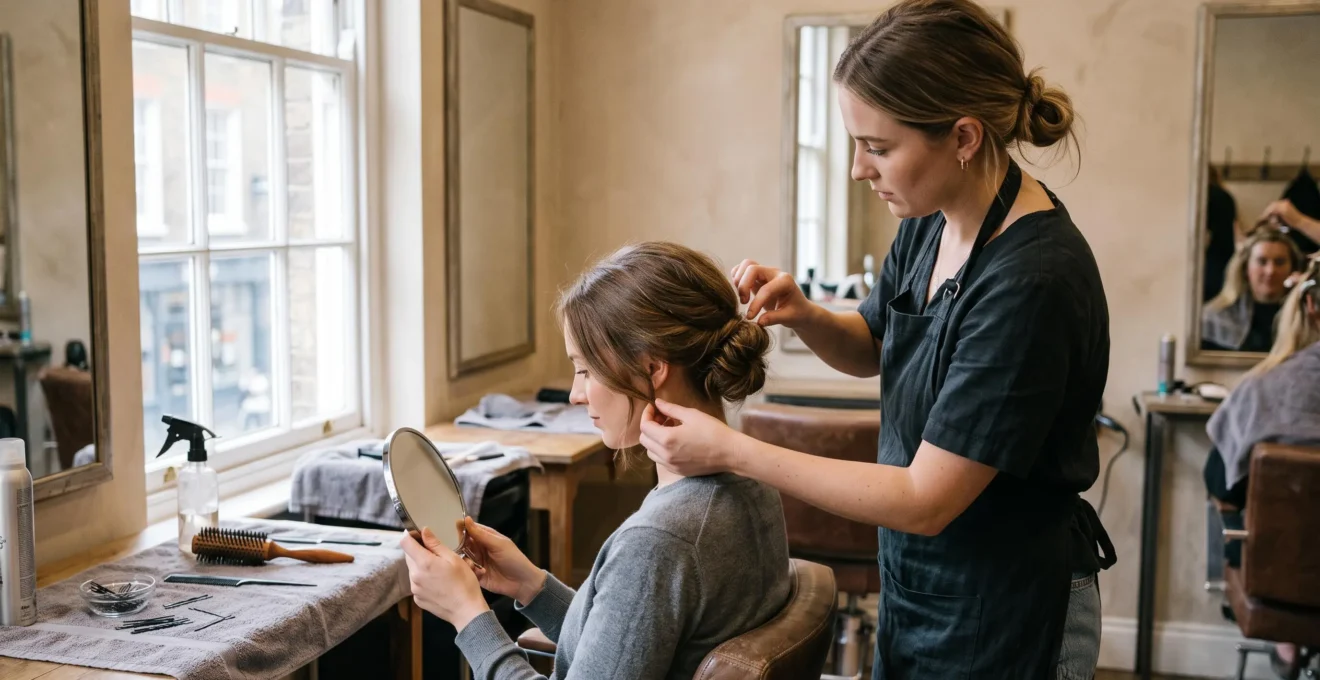
An elegant chignon does not need intricate twists, immaculate symmetry or a heavily sprayed finish. For a formal dinner, professional reception or evening event, the most convincing version often combines a secure inner structure with a softer, more natural-looking exterior.
The distinction between sophisticated occasion hair and an overly bridal appearance comes down to proportion, texture and restraint. A low or gently raised knot, subtle movement around the face and discreetly positioned pins can create a polished silhouette without making the hairstyle the centre of attention.
Comfort matters just as much as appearance. A chignon that pulls at the scalp, catches on a chair or gradually slips down the neck will become distracting during a long event. The answer is not to tighten everything: it is to establish a reliable foundation, distribute the weight and leave the visible sections relaxed.
The techniques below explain how to achieve that balance on fine, thick and medium-density hair, while keeping styling time and product use under control.
Elegant chignons: the essentials
- Soften the outline: keep the knot controlled, but release a little movement around the hairline and avoid excessive symmetry.
- Build hold beneath the surface: anchor pins into a prepared base rather than relying on tight wrapping or repeated coats of hairspray.
- Test the style before leaving: check comfort, head movement and contact with a chair, especially for a long seated event.
- Why Does Your Chignon Look Old-Fashioned Even With Modern Makeup?
- How Do You Build a Soft Chignon That Still Holds on Fine Hair?
- Low Chignon or Mid Chignon: Which One Feels More Comfortable for a 5-Hour Dinner?
- The Anchoring Mistake That Makes a Chignon Drop Lower and Lower All Night
- When Should You Add Texture Spray for a Chignon So It Doesn’t Go Sticky?
- Bobby Pins or U-Pins: Which One Holds Better in Thick Hair?
- Sleek Low Pony or Soft Waves: Which Looks More Polished for a Work Dinner?
- Which Elegant Hairstyle Looks Expensive Without Taking More Than 20 Minutes?
Why Does Your Chignon Look Old-Fashioned Even With Modern Makeup?
A chignon can look old-fashioned when its proportions and finish feel excessively formal, even alongside contemporary makeup. The usual culprits are a completely flattened hairline, a rigidly centred bun and perfectly symmetrical sections. Introducing slight crown lift, softer edges and a less exact knot often makes the same hairstyle appear more relaxed and modern.
The chignon itself is not outdated. Its effect depends on how deliberately every strand has been arranged. When the hair is pulled tightly backwards, coated in strong-hold spray and fixed into an immaculate circle, the overall impression can resemble traditional ceremonial styling rather than understated evening elegance.
Three visual details are particularly useful to examine:
- Parting: a sharply defined centre part combined with a tightly slicked bun can create a severe effect. A softly defined centre part, a side part or a loose front section may feel more contemporary.
- Volume distribution: a completely flat crown can make the bun appear disproportionately prominent. A small amount of lift above the knot helps balance the silhouette.
- Finish: a lacquered surface makes every section appear fixed. A lightly textured perimeter allows natural movement without sacrificing polish.
These are styling cues, not universal rules. A sleek centre-parted chignon can look strikingly contemporary with the right outfit. The goal is to choose the degree of structure deliberately.
Consider a practical before-and-after comparison. In the first version, every front section is pulled straight back, the bun is perfectly circular and no strands move near the face. In the second, the underlying knot remains secure, but the outer edge is gently loosened, one side sits slightly more freely and two small face-framing pieces are released.
Nothing essential has changed about the construction. Yet the second version appears less ceremonial because the eye sees movement and variation rather than absolute precision.
This adjustment also changes the relationship between hair and makeup. Extremely structured hair can make otherwise natural makeup seem comparatively understated. A softer hairstyle allows fresh skin, restrained eye makeup and a subtle lip colour to sit comfortably within the same overall look.
For a UK formal dinner or professional reception, aim for controlled softness rather than intentional messiness. Strands should look chosen, not accidentally escaping.
Once the outline looks balanced, the next consideration is constructing enough internal support to maintain that softness without constant readjustment.
How Do You Build a Soft Chignon That Still Holds on Fine Hair?
A soft chignon holds better on fine hair when the pins are secured into a small, prepared foundation instead of loose, slippery strands. Start with lightly textured hair, create a discreet twisted or braided anchor, wrap the outer lengths without excessive tension and insert the pins through that foundation. Structure provides security; tightness is not a substitute.
Fine hair presents a particular styling challenge. Individual strands may lie smoothly against one another, leaving less resistance for pins. When a loose knot is assembled without a foundation, the outer sections can gradually slide free, especially if the hair is freshly washed and very smooth.
The solution is to separate the supporting base from the visible finish. The base carries the hairstyle, while the outer sections create its elegant shape.
A practical construction method is:
- Prepare the hair. Brush through dry hair and apply a small amount of lightweight texturising product where the knot will sit. Day-old hair may be easier to manage, but freshly washed hair can also work with appropriate preparation.
- Create a foundation. Form a small low ponytail, a compact twisted section or a short braid in the intended anchor area.
- Add discreet grip. If necessary, backcomb a little hair near the base. Keep the teasing underneath the visible surface.
- Shape the chignon. Wrap the remaining lengths loosely around the foundation, keeping the exterior smooth enough to look deliberate.
- Secure the base. Insert pins so they catch the wrapped section and the foundation beneath it, using opposing directions where useful.
- Refine the outline. Gently ease out the sides and release a few fine strands around the face.
A small bun-maker can provide additional structure where hair length or density is insufficient to create a substantial knot. It should remain completely concealed, and its size should suit the natural volume of the hair.
This principle of building the main knot before adding softer outer sections is illustrated in ghd‘s Twisted Low Knot hairstyle tutorial. The demonstrated method forms a central low bun, wraps additional twisted side sections around it and loosens the front to create softness.
Product placement matters. Applying generous amounts of dry texture spray throughout fine hair can leave it stiff, dull or difficult to rearrange. Depending on the formula, buildup may also make strands clump instead of creating useful separation.
Concentrate grip products at the roots and foundation, using only enough to improve handling. The visible wrap generally needs less product than the supporting section.
Adding more pins is not automatically the answer. A dense cluster of small pins can become visible and create uncomfortable pressure while still failing to catch the actual foundation. Longer, appropriately sized pins positioned into the base may achieve a cleaner result with less hardware.
With the internal structure established, choosing the correct height becomes the next factor in creating an updo that remains comfortable through an extended evening.
Low Chignon or Mid Chignon: Which One Feels More Comfortable for a 5-Hour Dinner?
A low chignon is often a practical starting point for a five-hour seated dinner because it can distribute the hairstyle close to the nape and preserve a soft silhouette. However, a mid-height chignon may feel better if a low knot presses against the chair or collar. Comfort depends on weight, tension, positioning and the individual wearer.
The difference is not simply visual. Changing the height alters where the hairstyle’s weight is supported and which parts of the scalp experience pulling.
For someone wearing a formal dress with a low neckline, a compact nape chignon can create an uninterrupted line from the crown towards the shoulders. With a higher collar, however, the same knot may rub against fabric or become uncomfortable when the head moves.
A mid chignon can keep the hair clear of the neckline, particularly for an evening involving dancing or prolonged standing. Its placement may also expose tension around the temples or upper scalp if the hair is pulled too firmly towards one anchor point.
Neither height has been established as universally more comfortable for five hours. The following comparison is a practical styling guide rather than a measured durability or comfort ranking.
| Consideration | Low chignon | Mid chignon |
|---|---|---|
| Long seated dinner | Often practical if positioned clear of the chair back | Useful when a low knot would press against the chair |
| Standing and dancing | Works well with a secure compact base | Keeps the knot farther from the nape and collar |
| Long, heavy hair | May allow a compact arrangement close to the neck | Requires careful weight distribution and anchoring |
| High-neck outfit | Check for contact with the collar | May give better clearance |
| Visual impression | Soft, understated and elongated | More lifted and prominent |
Before leaving, sit in a chair similar to the one you expect to use and lean back normally. Then tilt your head sideways and look upwards. Notice whether the knot presses into the chair or whether any pin catches the hair painfully.
If discomfort appears, reposition the base instead of simply pulling out a few pins. Loosening an incorrectly positioned anchor can reduce stability without eliminating the pressure.
Scalp tension deserves particular attention. The American Academy of Dermatology‘s advice on hairstyles that pull identifies tightly secured buns and other pulling hairstyles as potential contributors to traction-related hair damage when tension is repeated. Pain and persistent pulling are signals to change the hairstyle.
« If your hairstyle feels painful, the style is too tight. »
This dermatological guidance does not establish that one chignon height causes more headaches than another, or that a single five-hour event causes traction alopecia. It does support a clear principle: persistent pain should never be accepted as the price of an elegant hairstyle.
For greater comfort, keep the wrap flexible, avoid concentrating all the weight on a few scalp points and choose a position that accommodates natural head movement.
The ideal height is ultimately the one that preserves the silhouette without creating pulling or pressure. Once it is selected, the pins must support that position consistently.
The Anchoring Mistake That Makes a Chignon Drop Lower and Lower All Night
A chignon often drops because the pins catch only its loose outer layers rather than securing the knot to a stable foundation. Downward movement, repeated head turns and the weight of the hair can gradually loosen that weak connection. The practical solution is to capture the bun’s base with properly sized pins placed in complementary directions.
The failure is usually gradual. A few strands shift slightly, the original knot loses its compact shape and the lower edge begins to sag. By the time the movement is visible from the front, the foundation may have loosened enough that adding another surface pin provides little improvement.
Pin direction can contribute to the problem. Pins inserted into unsupported loose strands, particularly when they follow the direction in which the hair naturally slides, may move rather than hold the knot. However, there is no established universal rule that every vertically inserted pin fails or that every horizontal pin prevents slipping.
The useful principle is secure engagement with the foundation, not one mandatory geometric angle.
For a low twisted chignon, try the following technique:
- Hold the finished wrap against the prepared base.
- Insert a suitable pin through a small amount of the outer wrapped hair.
- Guide the pin back into the underlying twist or foundation, capturing hair close to the scalp without pressing or scraping it.
- Add a second pin from a different direction so the support is not concentrated along one line.
- Repeat only where the knot moves, checking that the pins remain concealed and comfortable.
For an open U-pin, this may involve weaving the pin through the bun and underlying hair rather than pushing it straight through the centre. A bobby pin may be used to secure the flatter edges against the base.
As a practical styling choice, placing structural pins in opposing directions can help resist movement from more than one side. The exact placement should be adapted to the thickness of the hair, the knot’s shape and the style of pin. It is a professional technique, not a scientifically guaranteed hold pattern.
Test the result approximately 15 minutes after styling, allowing enough time for the hair to settle into its final position. Check the knot from the side, turn your head gently and lean back once. If the underside has started to loosen, reinforce the two lowest points into the foundation.
Avoid compensating for a slipping knot by tightening the initial ponytail. That increases tension at the scalp but does not necessarily improve the pins’ connection to the base. It can also produce the severe, pulled-back appearance that makes a chignon feel unnecessarily bridal.
Reliable anchors should make the style feel less restrictive, not more. With the mechanical structure secure, product can be used sparingly to control texture and finishing.
When Should You Add Texture Spray for a Chignon So It Doesn’t Go Sticky?
Apply lightweight texture spray before assembling the chignon, concentrating on the areas that need grip. This allows the product to reach the strands inside the twist rather than coating the finished surface. Once the knot is pinned, use only a minimal amount of flexible-hold hairspray if necessary to control flyaways or maintain the finish.
Texture products work best when their purpose is clear. A dry texturising spray can add separation and make smooth strands easier to arrange. A flexible finishing spray serves a different purpose: encouraging the visible style to remain in place without becoming rigid.
Problems can develop when both are repeatedly applied to the same section. Product accumulates on the exterior of the knot, making strands feel coated, stiff or tacky. Rather than improving the construction, this can make subsequent adjustments more difficult.
For that reason, divide application into two stages:
- Preparation: apply a modest amount of dry texture product around the intended anchor zone, working it through the hair according to the manufacturer’s instructions.
- Finishing: after pinning, use a light mist of flexible-hold spray only where the surface requires control.
Salt sprays can also contribute texture, but some formulas leave hair feeling noticeably dry or rough. They are not automatically the best choice for fine, fragile or already dry hair. Product selection should reflect the hair’s condition and the intended finish.
A practical styling example appears in Allure‘s short-hair updo tutorial, where dry texturising spray is applied before the hair is gathered into a low arrangement. The technique also incorporates crown backcombing and a loosely secured loop.
Although that tutorial addresses a wedding-related hairstyle, the preparation sequence is useful for building a less formal chignon. It illustrates how texture can be introduced before construction instead of being added heavily to the finished bun.
If a chignon softens during an event, first identify whether the problem is loose strands or an unstable foundation. For an isolated flyaway, a tiny amount of appropriate styling product applied with the fingertips may be sufficient. If the knot itself moves, resecure the underlying section before adding more spray.
Over-applying product is especially noticeable under bright restaurant lighting or flash photography, where a dull, coated texture may appear less natural than a few deliberately loose strands.
The aim is hair that looks touchable but remains organised. The next decision is choosing pins capable of carrying the knot’s weight without relying on product to compensate.
Bobby Pins or U-Pins: Which One Holds Better in Thick Hair?
U-pins are often useful for supporting the volume of a thick chignon, while bobby pins are effective for controlling flatter sections and small loose strands. Neither type is universally stronger. On dense, heavy hair, a combination of appropriately sized U-pins for the main knot and bobby pins for detailed finishing can provide a practical balance.
The difference lies in how the pins interact with hair. Conventional bobby pins use two closely positioned arms to grip sections together. Open-ended U-pins can be woven through a larger mass of hair, making them useful for securing twists and full buns without compressing every visible layer.
Thick hair creates a different challenge from fine hair. There may be ample texture for a pin to grip, but the volume and weight of the knot can exceed what several small pins comfortably support. Pins may bend, spring apart or fail to reach the stable foundation beneath the outer layers.
Length and gauge therefore matter, alongside correct insertion.
As explained in Allure’s hairstylist advice on using bobby pins, conventional bobby pins and open-ended hairpins serve different styling purposes. The article also discusses crossed bobby pins, pin dimensions and variations in professional insertion preferences.
These are practical hairstyling recommendations, not controlled comparisons showing that one pin type always provides longer hold.
| Styling requirement | Bobby pins | U-pins |
|---|---|---|
| Fine or medium-density hair | Useful for controlled anchoring of smaller sections | Suitable when a loose twist needs support |
| Thick or heavy chignon | Helpful for smaller details and supplementary support | Often useful for holding the main volume |
| Face-framing sections | Good for discreetly securing short strands | Less suited to very small, flat sections |
| Full twisted knot | Can reinforce the wrap | Can weave through the knot and its supporting base |
| Soft, relaxed finish | Controls escaping edges | Supports fuller shapes without necessarily flattening them |
For a hybrid method, construct the central knot and insert long U-pins from complementary directions, catching both the outer twist and the underlying foundation. Then use a few bobby pins to control visible ends and shorter pieces.
If a pin immediately bends or opens under the weight of the hair, replace it with a more suitable length or gauge rather than repeatedly inserting identical small pins.
Do not force a pin against the scalp. The hold should come from engaging the supporting hair, not pressing metal into the skin.
Once the appropriate hardware is selected, it becomes easier to decide whether a chignon is genuinely the best option for the occasion or whether a simpler style would create a more suitable impression.
Sleek Low Pony or Soft Waves: Which Looks More Polished for a Work Dinner?
A sleek low ponytail often creates the sharper impression for a structured professional outfit, while soft waves bring movement and a less formal finish. Neither is automatically more polished. The better choice depends on the neckline, hair texture, expected humidity, personal comfort and how much maintenance the style will need throughout the dinner.
For a work-related evening, polish is largely about consistency. The hairstyle should complement the clothing rather than compete with it. A tailored blazer, high-neck dress or sharply cut suit often pairs naturally with the clean lines of a low ponytail.
Soft waves can complement a fluid dress, softer tailoring or an open neckline. They introduce movement around the shoulders and can create a more relaxed impression in photographs.
But appearance at the beginning of an event is only one factor. Warm indoor conditions, movement, humidity and repeated contact with clothing can affect how waves retain their definition. The extent depends on natural hair texture and the styling method used.
A ponytail may preserve its overall silhouette more readily, but fine flyaways, a shifting part or a visible elastic can make it look less refined as the evening progresses. If tightly secured, it may also become uncomfortable.
For a quick comparison:
- Sleek low ponytail: best when clean lines, a defined part and a structured silhouette are priorities.
- Soft waves: useful when movement, softness and a less restrained appearance suit the outfit.
- Soft low chignon: a middle ground that controls the hair while preserving some texture and face-framing movement.
There is also a useful conversion advantage. A ponytail can become a chignon by twisting and wrapping its lengths around the base, then securing them with suitable pins. Waves can be gathered into a loose knot, allowing their existing texture to become part of the final shape.
On prepared hair, either conversion may be quick, potentially taking around two minutes for a simple construction. The actual time depends on length, density and how much reshaping is needed.
This flexibility can be useful when dressing for a professional dinner: begin with a neat base, then decide whether the final outfit benefits more from a ponytail, loose movement or an updo.
For a time-sensitive evening, the most successful hairstyle is usually the one that can be constructed reliably, looks intentional and requires little attention once the event begins.
What matters most before choosing your final style
- Start with the outfit’s silhouette and the amount of movement the hairstyle should provide.
- Spend styling time establishing a clean foundation and comfortable support rather than creating unnecessary complexity.
- Choose the simplest hairstyle that can maintain its intended shape under the conditions of the event.
Which Elegant Hairstyle Looks Expensive Without Taking More Than 20 Minutes?
A soft low chignon is a strong option for creating an expensive-looking hairstyle in under 20 minutes, provided the hair is already dry and manageable. Its refined appearance comes from a balanced silhouette, healthy-looking shine, discreet anchoring and a controlled but flexible finish. A sleek ponytail is usually simpler; polished waves require more heat styling.
Hair does not need an elaborate construction to look luxurious. A clearly defined part, a smooth but natural surface, considered face-framing sections and an absence of visible styling hardware can have a greater visual effect than multiple complicated twists.
The important distinction is between finish and complexity. A basic knot with thoughtful proportions can look more sophisticated than an intricate updo with uneven tension, exposed pins and excessive hairspray.
For someone preparing for a formal dinner after work, the following time budgets are practical planning estimates, not measured styling benchmarks. They assume dry hair, familiar tools and no need for a full wash or blow-dry.
| Styling stage | Soft low chignon | Sleek low pony | Polished waves |
|---|---|---|---|
| Brush-out and preparation | 5 minutes | 5 minutes | 4 minutes |
| Main styling | 10 minutes | 6 minutes | 13 minutes |
| Finishing | 5 minutes | 4 minutes | 3 minutes |
| Total | 20 minutes | 15 minutes | 20 minutes |
The sleek ponytail leaves the greatest margin for adjustment in this illustrative schedule. Soft waves may need more time if the hair is thick, very long or resistant to curling. A low chignon offers a useful compromise between control, versatility and formal elegance.
Under time pressure, protect the preparation stage rather than rushing directly into construction. A poorly defined part, tangled lengths or insufficient grip at the roots can make even an elaborate hairstyle look unfinished.
For the chignon, create a compact foundation, arrange the outer lengths around it and use the remaining minutes to correct the silhouette. Concentrate on what will be visible from the front, side and back.
Five checks before leaving for a formal evening
- Check the part and hairline: use a front-facing mirror to confirm that the part is intentional and the front sections frame the face without appearing rigid. The result should be a balanced front view.
- Check the foundation: gently touch the bun and confirm that the knot remains attached to its base without shifting. The result should be a stable central structure.
- Check the pin placement: inspect both sides and the underside with a second mirror, concealing or repositioning exposed pins. The result should be a clean outline with no uncomfortable metal contact.
- Check movement and comfort: turn your head, look upwards and sit back in a chair. The result should be comfortable movement without pulling, pressing or slipping.
- Check the final finish: release only the strands needed for softness and apply minimal finishing product where necessary. The result should be controlled texture without a stiff or visibly coated surface.
The checklist helps distinguish a style that merely looks good in a stationary mirror from one suitable for several hours of conversation, dining and movement.
A chignon that fails the comfort test needs its foundation or position corrected. A knot that feels secure but looks overly formal may need only a lighter perimeter and more relaxed face-framing sections.
Choose the low chignon when the aim is elegant, comfortable evening hair without an elaborate bridal finish. Prepare the base, secure the weight, soften the outline and perform the movement checks before leaving. That combination makes a simple knot feel deliberate, refined and appropriate for the occasion.
Can you wear a chignon with shoulder-length hair?
Yes. Shoulder-length hair can often be arranged into a compact low chignon using a small ponytail loop, a twisted foundation or discreet pins. Shorter layers may need individual securing, while a few loose pieces around the face can contribute to the softer finish. The achievable knot size depends on hair length and density.
Should a chignon be styled on freshly washed or second-day hair?
Either can work. Second-day hair may have enough natural grip to make styling easier, while freshly washed hair may benefit from a small amount of lightweight texture product. Hair that is heavily coated with oil or styling residue should be assessed before adding more product. The priority is manageable hair and a stable foundation.
How can you make a chignon suitable for a black-tie event without making it look bridal?
Maintain a deliberate, polished silhouette while avoiding unnecessary decoration or excessive rigidity. A softly defined part, compact knot and discreet pins can work well with formal eveningwear. If accessories are desired, choose one restrained detail that complements the outfit rather than adding several decorative elements.
What should you do if a chignon starts loosening halfway through an event?
Check whether the problem is a loose surface section or a moving foundation. A single escaping strand may be secured discreetly. If the entire knot has shifted, gently rebuild or reanchor the supporting section rather than tightening the hairstyle against the scalp. Avoid adding repeated layers of spray to conceal a structural problem.
Can a soft chignon stay elegant without hairspray?
Yes, depending on hair texture, weather conditions and the construction. A secure base, suitable pins and a well-controlled wrap may provide enough structure without finishing spray. Hair prone to flyaways or changes in humidity may benefit from a light flexible-hold product, but hairspray should not be relied on to support an inadequately anchored knot.